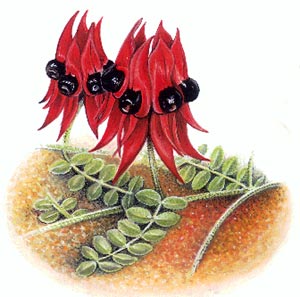
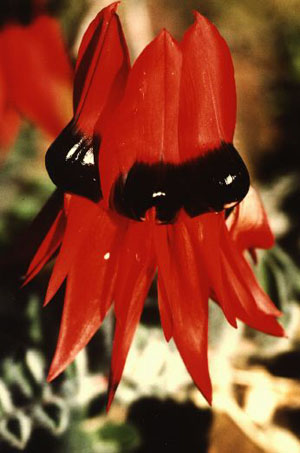
South Australia's official floral emblem was named for Charles Sturt, a most determined explorer who headed three important expeditions into Australia's arid interior in the mid 1800's. A prostrate, creeping plant celebrated for its striking blood red flowers. The flowers have prominent bumps in the middle which are usually black, but sometimes red and rarely white. Sturt's desert pea belongs to the genus Swainsona which contains more than 50 species, all confined to Australia and mostly to inland areas. Occuring in woodlands and on open plains, often as an ephemeral following rains, Sturt's desert pea can withstand the marked extremes of temperature experienced in central Australia, and light frosts are tolerated by established plants. Sturt's desert pea has an exceptionally long tap root to locate water deep in the soil. Afeter rain in good seasons the flowers from this plant can cover entire swale areas (flat valleys between dunes). Because of the popularity of this plant both in Australia and overseas, work is now being done to breed vigorous strains of Sturt's desert pea in a wide variety of colours for pot plant, cut flower, hanging basket and home garden cultivation. Commercial availability may also ease pressure on wild populations of Sturt's desert pea by discouraging the removal of flowers, seeds and plants from their natural habitat. The person who first described the plant, the plant author, is the Scottish botanist George Don (1798-1856). Not too long ago the scientific name of Sturt's desert pea was changed from Clianthus formosus to Swainsona formosa. The name Swainsona honors a scientist and plant cultivator of the late 18th century, Isaac Swainson who mantained a private botanic garden at Twickenham near London. The species name formosa is based on the Latin adjective formosus meaning 'finely formed, handsome, beautiful'.
|
|
|
 Distribution of theSturt's desert pea in Australia.



© Friends of the Australian Arid Lands Botanic Garden